
Childhood and today smartphone addiction ego and lost joy
There is something quietly powerful about remembering a childhood that felt full even when life was not easy.
You did not need much to feel alive. A ball, a street, a few friends, maybe a scraped knee and a loud laugh that echoed into the evening.
There was struggle, yes, but it did not define the day. Joy had more space.
Now look around.
Children are still here, but their world feels different. Parks exist, yet they are quieter. Swings move slower.
The loud chorus of children’s voices has been replaced by something softer, more isolated.
Heads tilted down. Fingers moving fast. Eyes fixed on a glowing screen.
It is not technology as a whole that changed everything. The computer stayed in one place.
It demanded intention. You sat down, you used it, you left. There was a boundary.
But the phone crossed that line. It followed us everywhere. Into our pockets, into our beds, into our most private moments.
It did not ask for attention. It took it.
And slowly, almost invisibly, it reshaped behavior.
Children no longer wait in boredom, and that matters more than it seems.
Boredom used to create imagination. A stick could become a sword, a spaceship, a story.
Now boredom is eliminated instantly with a swipe. But along with it, something deeper disappears.
Creativity becomes passive. Experiences become consumed instead of lived.
Then comes ego.
Not the natural kind that grows quietly inside a person, but the kind that feeds on visibility. Likes, views, followers.
A new scoreboard. Childhood used to be about being present. Now it risks becoming a performance.
Even at a young age, there is an awareness of being seen, judged, compared.
And comparison is heavy.
A child no longer compares their life with the kid next door.
They compare it with thousands of curated lives.
Perfect moments, edited realities, endless highlights.
It creates a subtle dissatisfaction, a feeling that something is missing even when everything is fine.
This is where dependency begins.
Not just on the device, but on validation.
On distraction. On constant stimulation. Silence becomes uncomfortable.
Stillness feels strange. The mind, instead of wandering freely, starts seeking the next input.
So are today’s children less happy
It is not that simple.
They have access to knowledge we never imagined.
They can learn faster, connect globally, express themselves in new ways.
But the cost is attention. And attention shapes experience. When attention is fragmented, joy becomes fragmented too.
The real loss is not just books being forgotten or parks becoming quiet.
It is depth.
Reading a book requires patience. It builds focus.
It allows a child to sit inside a world and stay there.
Without interruptions.
Without noise.
That kind of experience is becoming rare. And with it, we are slowly losing the ability to feel deeply, to imagine fully, and to think at our own pace.
This is not about blaming a tool completely. Technology reflects human behavior as much as it shapes it.
The real question is how it is used and what replaces what.
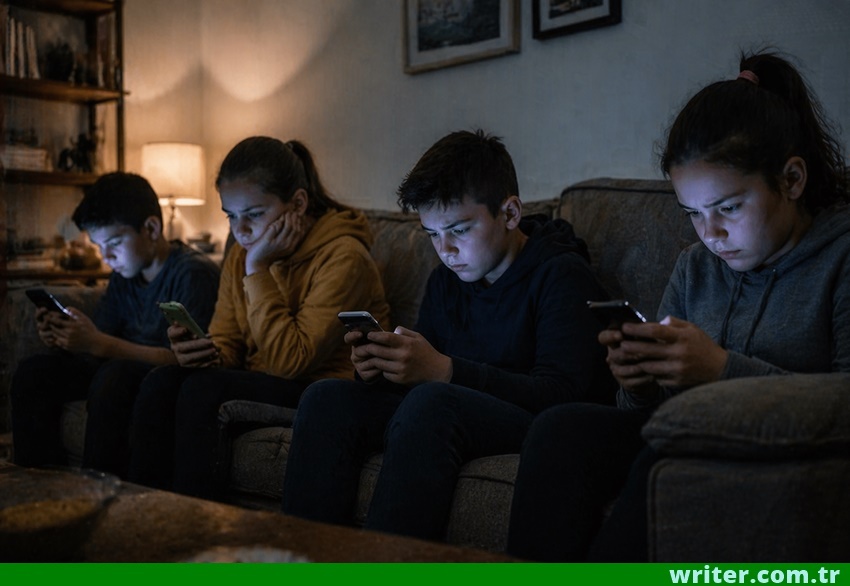
If a phone replaces connection, movement and curiosity then something important is lost.
But if it supports learning, creativity, and meaningful interaction, then it becomes just another tool.
The balance is fragile.
On writer.com.tr, this is exactly where writing finds its place again.
Writing slows things down. It forces thought to take shape. It invites reflection instead of reaction.
In a world that moves fast and demands constant attention, writing becomes a quiet rebellion.
A way to return to depth.
Maybe the goal is not to go back completely. That world is gone.
But parts of it can still be protected. A child laughing loudly in a park. A moment without a screen. A page being turned slowly.
Those things still matter.
More than ever.