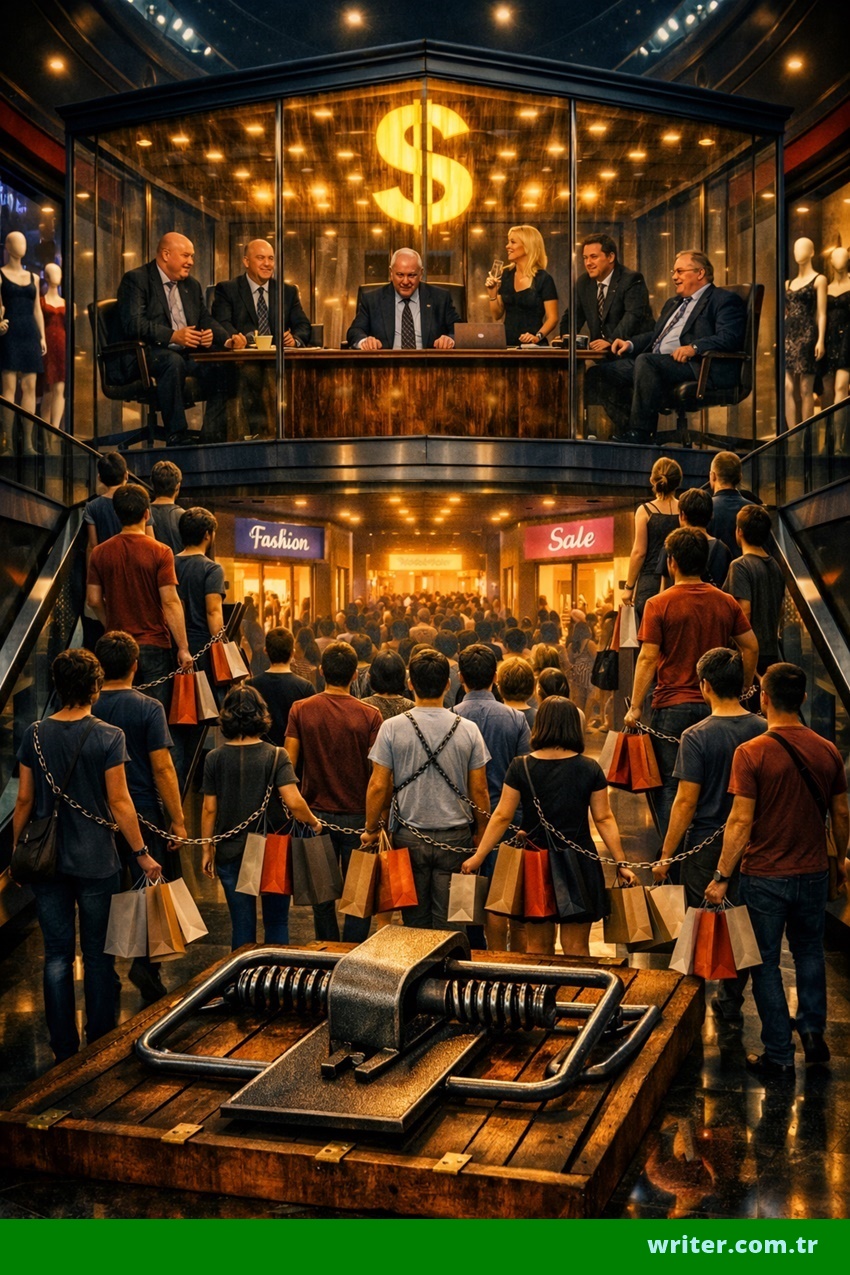
Capitalism Trap
Capitalism does not just sell products.
It sells a feeling that never fully arrives.
It dresses itself like freedom, like choice, like possibility.
But underneath, it runs on something much simpler.
Your dissatisfaction.
Shiny windows are not there to show you what you need.
They are there to remind you of what you supposedly lack.
And over time, a quiet equation settles in your mind.
Buying becomes relief.
Wanting becomes normal.
Never having enough becomes your baseline.
This is how the illusion is reinforced.
Consumption feeds dissatisfaction.
Dissatisfaction feeds more consumption.
And somewhere in between, happiness is simulated but never sustained.
You wake up and reach for your phone.
Not to live, but to compare.
Lives look smoother than yours.
Faces brighter. Homes cleaner. Success louder.
You are not just observing anymore.
You are measuring.
And suddenly, being is not enough.
Now you must improve, upgrade, optimize, display.
Even your peace is packaged.
Buy this to relax.
Subscribe to feel calm.
Watch this to escape.
Your inner silence now comes with a price tag.
You start chasing a version of yourself that always moves one step further away.
Not by accident.
By design.
Because a satisfied mind does not keep buying.
A content person is a broken customer.
So the system keeps you slightly restless.
Slightly incomplete.
Just enough to continue.
Work more to earn more.
Earn more to spend more.
Spend more to feel more.
Then feel empty again.
A perfect loop.
Not loud. Not violent.
Just constant.
And quietly, almost invisibly, something important disappears.
The joy of enough.
The beauty of stillness.
The richness of a moment that does not need to be shared to be real.
This is where the writer.com.tr steps in.
Not to destroy the system.
But to see through it.
To realize that greed is never natural, it's taught.
To pause in a world that rewards endless movement.
To create without turning everything into value.
To exist without questioning how valuable it is.
The world will continue to sell you more.
More speed. More noise. More desire.
But you do not have to accept the script.
You can step outside the cycle.
You can refuse the illusion.
You can choose enough.
And in that quiet refusal, something powerful happens.
For the first time, nothing is missing.
Live Minimally. Stay Calm in a Noisy World.
Minimalism is not about owning less for the sake of aesthetics.
It is about removing what distracts you from what truly matters.
At its core, minimalism is intentional living.
It is choosing clarity over chaos.
It is deciding that your time, energy, and attention are more valuable than possessions.
In a world that constantly tells you to buy more, scroll more, upgrade more, minimalism quietly asks a radical question:
What if enough is already enough?
The Silent Pressure of Modern Capitalism
Modern capitalism thrives on dissatisfaction.
You are encouraged to feel incomplete.
Not productive enough.
Not successful enough.
Not attractive enough.
Every advertisement whispers the same message:
You need something more.
The result is subtle but powerful anxiety.
Your home fills up.
Your schedule fills up.
Your mind fills up.
But your inner peace slowly empties.
Minimalism interrupts this cycle.
It refuses to measure worth by accumulation.
It reminds you that peace cannot be purchased.
Technology Addiction: The Invisible Overload
Technology promised convenience.
And it delivered speed.
But speed is not the same as calm.
Notifications fragment your attention.
Endless scrolling overstimulates your brain.
Comparison culture quietly erodes self-worth.
Studies show that constant digital stimulation increases stress hormones and reduces deep focus. Your nervous system was not designed for 24-hour input.
When your mind never rests, your body cannot relax.
Minimalism in the digital age means reclaiming your attention.
Because attention is life.
Where your attention goes, your emotional state follows.
Why Minimalism Creates Calm
A minimal environment reduces visual stress.
Fewer decisions reduce mental fatigue.
Less noise allows deeper awareness.
Psychologists call it decision fatigue. The average adult makes over 30,000 decisions per day. Many of them are unnecessary.
When you simplify your surroundings, you simplify your thinking.
When you simplify your thinking, your nervous system slows down.
Calm is not something you chase.
It is something that appears when excess disappears.
Practical Ways to Live Minimally and Stay Calm
Declutter one small area at a time.
Not your entire house. Just one drawer today.
Apply the 30-day rule before buying non-essential items.
If you still need it after 30 days, reconsider.
Create technology boundaries.
No phone for the first 30 minutes after waking up.
No screen one hour before sleep.
Reduce digital noise.
Turn off non-essential notifications.
Unfollow accounts that trigger comparison.
Simplify your schedule.
If everything feels urgent, nothing truly is.
Leave empty space in your calendar.
Practice mindful consumption.
Ask before every purchase:
Does this add value or just distraction?
The Courage to Choose Less
Minimalism is not about deprivation.
It is about liberation.
It is the courage to step away from constant stimulation.
The courage to disconnect from comparison.
The courage to define success on your own terms.
You do not need a bigger life.
You need a clearer one.
When you remove the unnecessary, what remains becomes visible.
Your breath.
Your thoughts.
Your relationships.
Your present moment.
And in that space, calm naturally returns.
Capitalism tells you to want more.
Minimalism teaches you to need less.
Peace begins when enough becomes enough.
Capitalism teaches you that happiness is something you purchase.
Minimalism reminds you that happiness is something you protect.
about capitalism and minimalism,capitalism,minimalism,writer.com.tr,minimalist
writer.com.tr,minimalism,Article on capitalism and minimalism
capitalism,minimalist